

The Wire: Month in review - September ‘26 | AI generated image by XBTO
The Wire: Month in review - September ‘26 | AI generated image by XBTO
Past 12 months performance
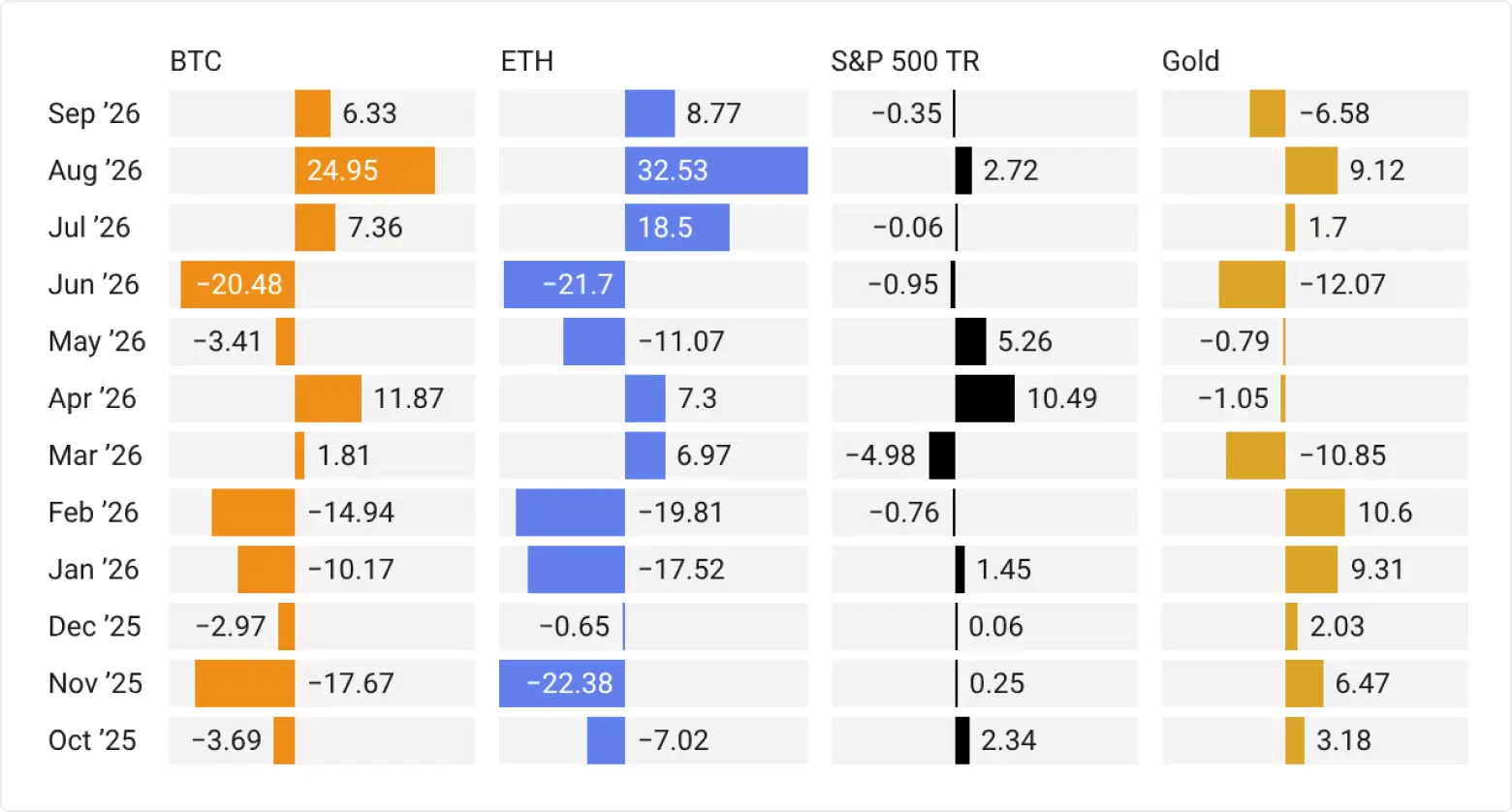
Source: CoinGlass for BTC and ETH. S&P for S&P 500 TR and GoogleFinance COMEX:GCW00 for Gold. Created with Datawrapper.
September was the month institutional demand proved strong enough to keep crypto advancing despite one of the sharpest deteriorations in the global rates backdrop in years. Bitcoin rose, alts generally outperformed, and adoption progressed, but every rally ultimately ran into the same wall of oil, inflation and 5%-plus bond yields.
1. Bitcoin: a positive month, but one defined by macro resistance.
Bitcoin rose 6.3% in September, from roughly $78.5K at the end of August to $83.6K at month-end. The path was anything but smooth: BTC fell to $75K around mid-month as oil surged, the Fed turned hawkish and the US crypto bill failed, then rebounded above $87,000 as ETF inflows accelerated and energy prices temporarily eased. It finished below that peak as Treasury yields above 5% ultimately capped the rally.
2. The major alts outperformed Bitcoin.
ETH gained about 8.8%, SOL 14.6%, XRP 7.9% and HYPE roughly 8.2% over the month. SOL was the clear major-coin outperformer, while HYPE briefly approached $98; broader altcoins generally gained ground against BTC during the stronger risk-on phases of the month. The pattern is similar to last month, and suggests investors were willing to move further out on the risk curve when macro conditions improved, although that rotation stalled whenever yields and the dollar moved sharply higher.
3. Tokenisation and stablecoins became the clearest structural themes.
The SEC created a five-year exemption for genuine tokenised US equities, Nasdaq committed $100m to Kraken parent Payward to develop tokenised-market infrastructure, and the Federal Reserve began implementing the GENIUS Act framework for regulated payment stablecoins. These developments were not responsible for day-to-day Bitcoin moves, but they strengthened the underlying institutional-adoption narrative at a time when macro conditions were otherwise hostile.
4. ETF demand became Bitcoin's most important internal support.
US spot Bitcoin ETFs absorbed about $2.65bn during September, while Ether ETFs added roughly $832m. The most revealing period came late in the month, when Bitcoin funds took in close to $3bn across a run of positive sessions even as Treasury yields climbed. That buying helped explain why BTC remained relatively resilient despite deteriorating macro conditions.
5. September marked the return of global monetary tightening.
The Federal Reserve raised rates for the first time since 2023, taking its benchmark range to 3.75–4.00%; the ECB lifted its deposit rate to 2.50%; and the Bank of Japan raised rates to 1.25%, the highest in 31 years. Crypto therefore spent much of September adjusting to an important regime change: the expected easing cycle had turned into synchronised inflation-fighting across major economies.
6. The Iran conflict turned oil into the month's central macro variable.
Brent rose about 14% in September, as disruption around the Strait of Hormuz, attacks on Saudi infrastructure and pressure on Red Sea routes raised fears of a prolonged supply shock. Later in the month, exports recovered materially, limiting the worst-case scenario. For Bitcoin, oil mattered primarily through inflation expectations: every escalation strengthened the case for higher rates, while every improvement in physical flows supported the opposite trade.
7. The bond market eventually became a bigger problem than the Fed.
September was one of the worst months for sovereign bonds in years; the US 10-year Treasury yield recorded its largest monthly increase since 2022 and eventually moved above 5%. Even softer US inflation late in the month struggled to pull long yields sustainably lower. That kept the opportunity cost of holding Bitcoin unusually high and explains why strong ETF demand produced consolidation rather than an uninterrupted rally.
8. Washington failed to deliver crypto's long-awaited legislative framework.
The Senate voted 50–49 to advance the CLARITY Act on September 15, ten votes short of the required threshold. Bitcoin fell more than 5% as the outcome became clear, while Coinbase and Circle dropped as much as 10%. The setback mattered because it removed the prospect of durable congressional rules this year, although subsequent SEC and CFTC actions showed that regulatory progress could continue through agencies.
9. AI remained both a support for risk assets and a complication for monetary policy.
AI-driven capital spending kept technology shares, semiconductor demand and broader US economic activity surprisingly resilient despite high rates. That supported the risk appetite in which crypto participated, but policymakers increasingly cited AI investment as one reason demand (and potentially inflation) was proving stronger than expected. In other words, the same boom helping Nasdaq and Bitcoin sentiment was also contributing to the higher-yield environment constraining them.
10. The month ended with a more nuanced macro picture than it began.
US PCE inflation surprised modestly to the downside at month-end, giving the Fed more room to pause, even as consumer spending remained strong and the energy shock persisted. Meanwhile Middle Eastern crude exports recovered substantially despite the conflict. September therefore finished with Bitcoin caught between two powerful forces: improving crypto-specific demand and adoption on one side, and unusually expensive global capital on the other.
Collapse
The full breakdown
In our first article, "Navigating Crypto Volatility: The Advantages of Active Management," we explored how the high volatility and low correlation of digital assets with traditional asset classes create unique opportunities for active managers. We discussed how these characteristics enable active managers to execute tactical trading strategies, capitalizing on short-term price movements and market inefficiencies. Building on that foundation, we now turn our attention to the unique market microstructure of digital assets.
Conducive market microstructure of digital assets
The market microstructure of digital assets - a framework that defines how crypto trades are conducted, including order execution, price formation, and market interactions - sets the stage for active management to thrive. This unique ecosystem, characterized by its continuous trading hours, diverse trading venues, and substantial market liquidity, offers several advantages for active management, providing a fertile ground for sophisticated investment strategies.
24/7/365 market access
One of the defining characteristics of digital asset markets is their continuous, round-the-clock operation.
Unlike traditional financial markets that operate within specific hours, cryptocurrency markets are open 24 hours a day, seven days a week, all year round. This continuous trading capability is particularly advantageous for active managers for several reasons:
- Immediate response to market events: Unlike traditional markets that close after regular trading hours, digital asset markets allow managers to react immediately to breaking news or events that could impact asset prices. For instance, if a significant economic policy change occurs over the weekend, managers can adjust their positions in real-time without waiting for markets to open.
- Managing volatility: Continuous trading provides more opportunities to capitalize on price movements and volatility. Active managers can take advantage of this by implementing strategies such as short-term trading or hedging to mitigate risks and lock in gains whenever market conditions change. For instance, if there’s a sudden drop in the price of Bitcoin, managers can quickly sell their holdings to minimize losses or buy in to capitalize on the lower prices.
Variety of trading venues
The proliferation and variety of trading venues is another crucial element of the digital asset market structure. The extensive landscape of over 200 centralized exchanges (CEX) and more than 500 decentralized exchanges (DEX) offers a wide array of platforms for cryptocurrency trading. This diversity is beneficial for active managers in several ways:
- Risk management and diversification: By spreading trades across various exchanges, active managers can mitigate counterparty risk associated with any single platform. Additionally, the ability to trade on both CEX and DEX platforms allows managers to diversify their strategies, incorporating different levels of decentralization, regulatory environments, and security features.
- Arbitrage opportunities: Different venues often exhibit price discrepancies, presenting arbitrage opportunities. For example, managers can buy an asset on one exchange at a lower price and sell it on another where the price is higher, thus generating risk-free profits.
- Access to diverse liquidity pools: Multiple trading venues provide access to diverse liquidity pools, ensuring that managers can execute large trades without significantly impacting the market price.
Spot and derivatives markets (Variety of instruments)
The seamless integration of spot and derivatives markets within the digital asset space presents a considerable advantage for active managers. With substantial liquidity in both markets, they can implement sophisticated trading strategies and manage risk more effectively.
For instance, as of August 8 2024, Bitcoin (BTC) boasts a daily spot trading volume of $40.44 billion and an open interest in futures of $27.75 billion. Additionally, derivatives such as futures, options, and perpetual contracts enable managers to hedge positions, leverage trades, and employ complex strategies that can amplify returns.

Overall, the benefits for active managers include:
- Hedging and risk management: Derivatives offer a powerful tool for hedging against unfavorable price movements, enabling more efficient risk management. For instance, a manager holding a substantial amount of Bitcoin in the spot market can use Bitcoin futures contracts to safeguard against potential price drops, thereby enhancing risk control.
- Access to leverage: Managers can use derivatives to leverage their positions, amplifying potential returns while maintaining control over risk exposure. For instance, by employing options, a manager can gain exposure to an underlying asset with only a fraction of the capital needed for a direct spot purchase, thereby enabling more capital-efficient investment strategies.
- Strategic flexibility: By integrating spot and derivatives markets, managers can implement sophisticated strategies designed to capitalize on diverse market conditions. For instance, they may engage in volatility selling, where options are sold to generate income from market volatility, regardless of price direction. Additionally, managers can leverage favorable funding rates in perpetual futures markets to enhance yield generation. Basis trading, another strategy, involves taking offsetting positions in spot and futures markets to profit from price differentials, enabling returns that are independent of market movements.
Exploiting market inefficiencies
Digital asset markets, being relatively nascent, are less efficient compared to traditional financial markets. These inefficiencies arise from various factors, including regulatory differences, market segmentation, and varying levels of market maturity. For example:
- Pricing anomalies: Phenomena like the "Kimchi premium," where cryptocurrency prices in South Korea trade at a premium compared to other markets, create arbitrage opportunities. Managers can exploit these by buying assets in one market and selling them in another at a higher price.
- Exploiting mispricings: Active managers can identify and capitalize on mispricings caused by market inefficiencies, using strategies such as statistical arbitrage and mean reversion.
The unique aspects of the digital asset market structure create an exceptionally conducive environment for active management. Continuous trading hours and diverse venues provide the flexibility to react quickly to market changes, ensuring timely execution of trades. The availability of both spot and derivatives markets supports a wide range of sophisticated trading strategies, from hedging to leveraging positions. Market inefficiencies and pricing anomalies offer numerous opportunities for generating alpha, making active management particularly effective in the digital asset space. Furthermore, the ability to hedge and manage risk through derivatives, along with exploiting uncorrelated performance, enhances portfolio resilience and stability.
In our next article, we'll delve into the various techniques active managers employ in the digital asset markets, showcasing real-world use cases.
Read full disclaimer


