
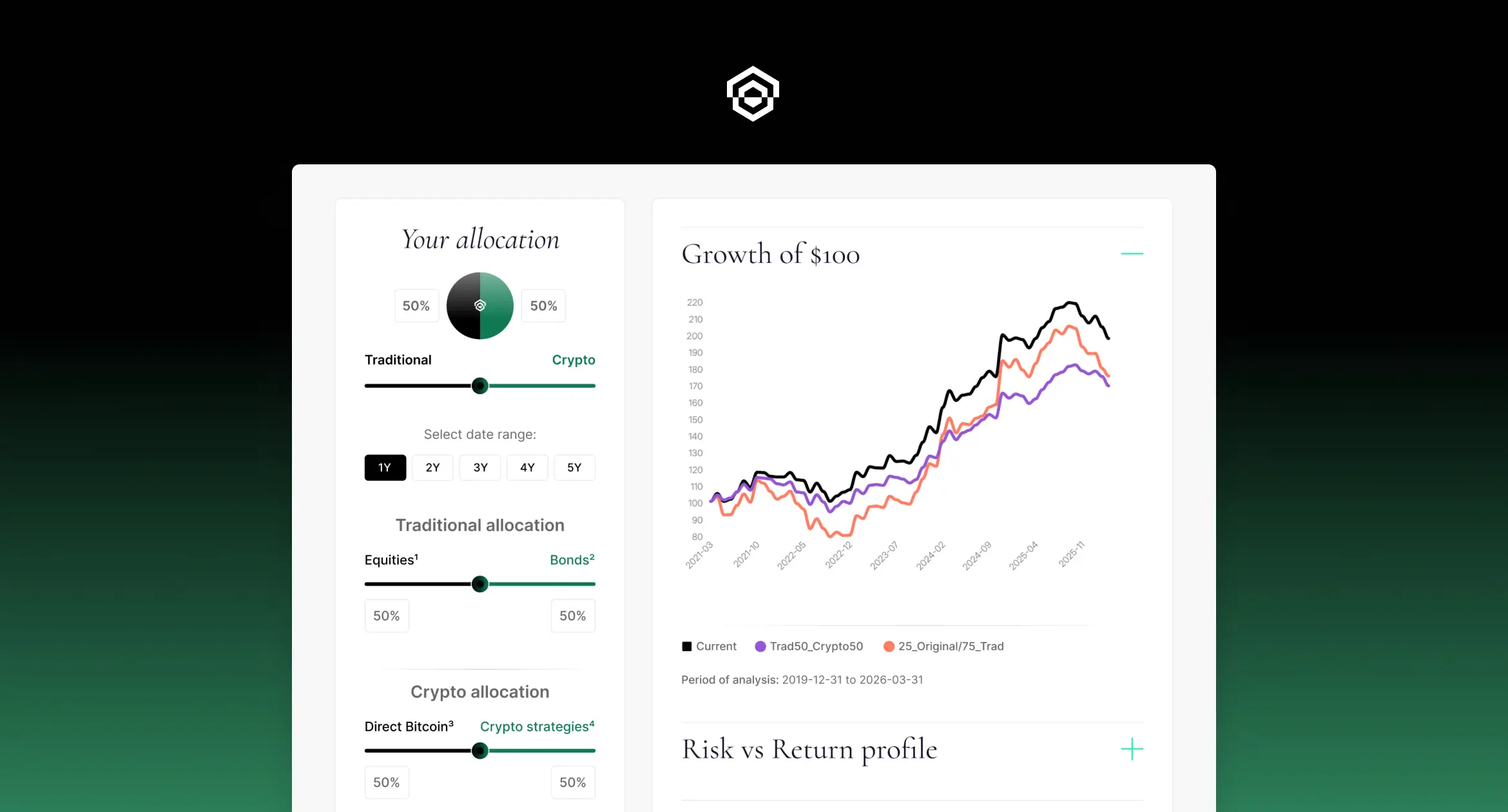
XBTO launches interactive allocator to assess digital assets in portfolio context | Image by XBTO
XBTO launches interactive allocator to assess digital assets in portfolio context | Image by XBTO
New allocator leverages historical multi-asset data to support institutional portfolio construction decisions.
XBTO, a global digital asset investment firm, has launched an institutional-grade portfolio allocation tool designed to help investors evaluate the role of digital assets within traditional portfolios. Originally developed for portfolio discussions with institutional clients, including with sovereign wealth funds, family offices, and asset managers, the tool is now being made available more broadly through XBTO’s website.
The XBTO Digital Asset Allocator allows users to construct portfolios across traditional asset classes, equities and fixed income, alongside Bitcoin and actively managed digital asset strategies, and assess their impact using historical performance data.
The tool draws on historical datasets across market cycles, allowing investors to analyze how allocations would have behaved under different conditions, including periods of market stress and regime shifts.
“Digital assets have moved from the periphery to the allocation discussion,” said Karl Naim, Group Chief Commercial Officer at XBTO. “The challenge today is not access, but integration. Institutional investors need tools that allow them to evaluate digital assets using the same rigor applied to equities or fixed income. This allocator is designed to bring that discipline into the decision-making process.”
The allocation tool provides real-time analysis of key portfolio metrics, including returns, volatility, drawdowns, and risk-adjusted performance. It also enables comparison between passive Bitcoin exposure and actively managed strategies.
"We built this tool to help investors assess digital assets the way sophisticated allocators assess any asset: in portfolio context.” added Gabriel Karageorgiou, Investment Strategist at XBTO. “In isolation, crypto can appear defined by volatility and drawdowns. In a portfolio context, however, even a small allocation can have an outsized impact on portfolio efficiency. That shifts the conversation from novelty to strategic relevance.”
The launch reflects a broader shift in how digital assets are being assessed, moving from speculative positioning toward strategic portfolio integration.
Explore the XBTO Digital Asset Allocator: xbto.com/digitalassetallocator
About XBTO
From trading and custody, wealth and asset management, to capital markets, XBTO helps clients capture investment opportunities in the age of digital assets. Founded in 2015 as a proprietary trading firm, XBTO built its foundation through over a decade of active participation in digital asset markets.
Since 2023, XBTO has evolved into a vertically integrated digital assets investment firm, spanning capital markets, regulated custody and trading, and quantitative wealth and asset management. The firm’s asset management arm leverages deep Bitcoin expertise to deploy risk-adjusted strategies across the alpha-beta continuum, designed to perform across market cycles and regulatory environments. Complementing this technical rigor, XBTO’s trading and custody divisions offer bespoke/white glove services to institutional and HNWI clients.
With decades of experience earned as a leading financial institution with deep expertise in digital markets, XBTO brings a rare combination of financial discipline and digital-native insight. XBTO operates under robust regulatory oversight, with operating entities regulated by the Bermuda Monetary Authority and the Financial Services Regulatory Authority in Abu Dhabi. It operates from key financial hubs including Bermuda, New York, Miami, London, Paris, and Abu Dhabi.
For media enquiries:
Aroma Kumar
Marketing & Communications Manager
aroma.kumar@xbto.com
Collapse
The full breakdown
In our first article, "Navigating Crypto Volatility: The Advantages of Active Management," we explored how the high volatility and low correlation of digital assets with traditional asset classes create unique opportunities for active managers. We discussed how these characteristics enable active managers to execute tactical trading strategies, capitalizing on short-term price movements and market inefficiencies. Building on that foundation, we now turn our attention to the unique market microstructure of digital assets.
Conducive market microstructure of digital assets
The market microstructure of digital assets - a framework that defines how crypto trades are conducted, including order execution, price formation, and market interactions - sets the stage for active management to thrive. This unique ecosystem, characterized by its continuous trading hours, diverse trading venues, and substantial market liquidity, offers several advantages for active management, providing a fertile ground for sophisticated investment strategies.
24/7/365 market access
One of the defining characteristics of digital asset markets is their continuous, round-the-clock operation.
Unlike traditional financial markets that operate within specific hours, cryptocurrency markets are open 24 hours a day, seven days a week, all year round. This continuous trading capability is particularly advantageous for active managers for several reasons:
- Immediate response to market events: Unlike traditional markets that close after regular trading hours, digital asset markets allow managers to react immediately to breaking news or events that could impact asset prices. For instance, if a significant economic policy change occurs over the weekend, managers can adjust their positions in real-time without waiting for markets to open.
- Managing volatility: Continuous trading provides more opportunities to capitalize on price movements and volatility. Active managers can take advantage of this by implementing strategies such as short-term trading or hedging to mitigate risks and lock in gains whenever market conditions change. For instance, if there’s a sudden drop in the price of Bitcoin, managers can quickly sell their holdings to minimize losses or buy in to capitalize on the lower prices.
Variety of trading venues
The proliferation and variety of trading venues is another crucial element of the digital asset market structure. The extensive landscape of over 200 centralized exchanges (CEX) and more than 500 decentralized exchanges (DEX) offers a wide array of platforms for cryptocurrency trading. This diversity is beneficial for active managers in several ways:
- Risk management and diversification: By spreading trades across various exchanges, active managers can mitigate counterparty risk associated with any single platform. Additionally, the ability to trade on both CEX and DEX platforms allows managers to diversify their strategies, incorporating different levels of decentralization, regulatory environments, and security features.
- Arbitrage opportunities: Different venues often exhibit price discrepancies, presenting arbitrage opportunities. For example, managers can buy an asset on one exchange at a lower price and sell it on another where the price is higher, thus generating risk-free profits.
- Access to diverse liquidity pools: Multiple trading venues provide access to diverse liquidity pools, ensuring that managers can execute large trades without significantly impacting the market price.
Spot and derivatives markets (Variety of instruments)
The seamless integration of spot and derivatives markets within the digital asset space presents a considerable advantage for active managers. With substantial liquidity in both markets, they can implement sophisticated trading strategies and manage risk more effectively.
For instance, as of August 8 2024, Bitcoin (BTC) boasts a daily spot trading volume of $40.44 billion and an open interest in futures of $27.75 billion. Additionally, derivatives such as futures, options, and perpetual contracts enable managers to hedge positions, leverage trades, and employ complex strategies that can amplify returns.

Overall, the benefits for active managers include:
- Hedging and risk management: Derivatives offer a powerful tool for hedging against unfavorable price movements, enabling more efficient risk management. For instance, a manager holding a substantial amount of Bitcoin in the spot market can use Bitcoin futures contracts to safeguard against potential price drops, thereby enhancing risk control.
- Access to leverage: Managers can use derivatives to leverage their positions, amplifying potential returns while maintaining control over risk exposure. For instance, by employing options, a manager can gain exposure to an underlying asset with only a fraction of the capital needed for a direct spot purchase, thereby enabling more capital-efficient investment strategies.
- Strategic flexibility: By integrating spot and derivatives markets, managers can implement sophisticated strategies designed to capitalize on diverse market conditions. For instance, they may engage in volatility selling, where options are sold to generate income from market volatility, regardless of price direction. Additionally, managers can leverage favorable funding rates in perpetual futures markets to enhance yield generation. Basis trading, another strategy, involves taking offsetting positions in spot and futures markets to profit from price differentials, enabling returns that are independent of market movements.
Exploiting market inefficiencies
Digital asset markets, being relatively nascent, are less efficient compared to traditional financial markets. These inefficiencies arise from various factors, including regulatory differences, market segmentation, and varying levels of market maturity. For example:
- Pricing anomalies: Phenomena like the "Kimchi premium," where cryptocurrency prices in South Korea trade at a premium compared to other markets, create arbitrage opportunities. Managers can exploit these by buying assets in one market and selling them in another at a higher price.
- Exploiting mispricings: Active managers can identify and capitalize on mispricings caused by market inefficiencies, using strategies such as statistical arbitrage and mean reversion.
The unique aspects of the digital asset market structure create an exceptionally conducive environment for active management. Continuous trading hours and diverse venues provide the flexibility to react quickly to market changes, ensuring timely execution of trades. The availability of both spot and derivatives markets supports a wide range of sophisticated trading strategies, from hedging to leveraging positions. Market inefficiencies and pricing anomalies offer numerous opportunities for generating alpha, making active management particularly effective in the digital asset space. Furthermore, the ability to hedge and manage risk through derivatives, along with exploiting uncorrelated performance, enhances portfolio resilience and stability.
In our next article, we'll delve into the various techniques active managers employ in the digital asset markets, showcasing real-world use cases.
Read full disclaimer


