
The Wire: Month in review - October ‘26 | AI generated image by XBTO
Past 12 months performance
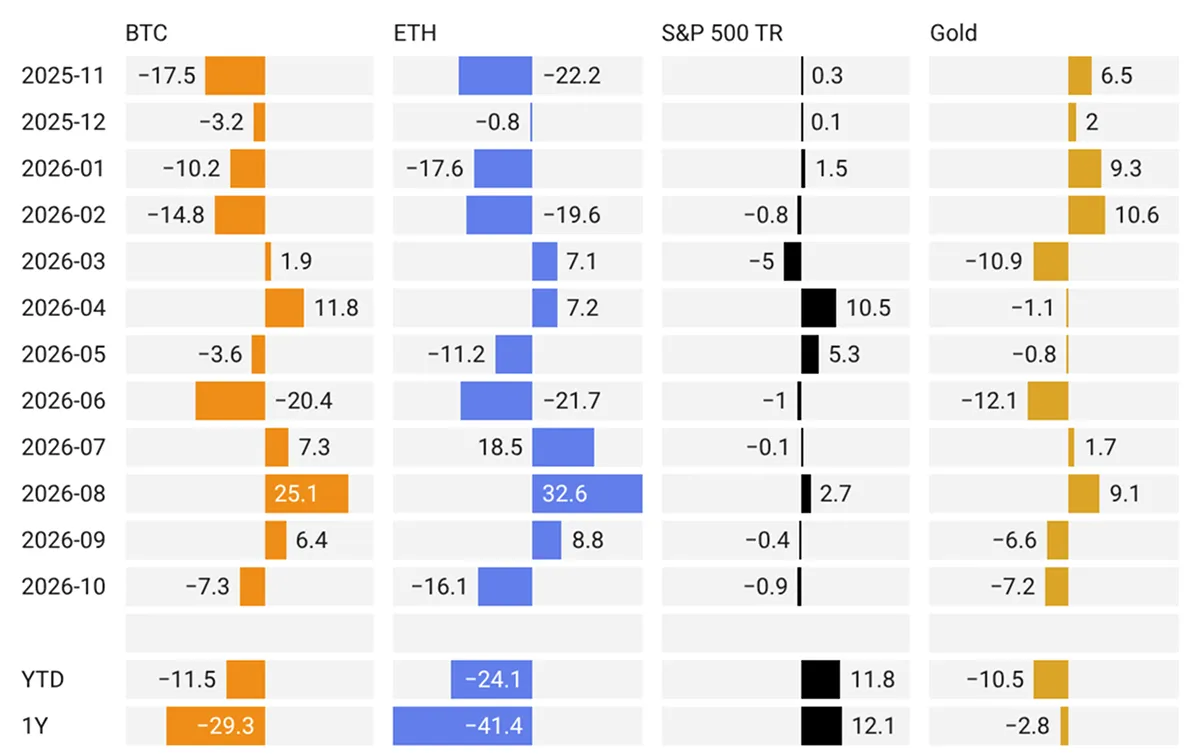
Source: CoinGlass for BTC and ETH. S&P for S&P 500 TR and GoogleFinance COMEX:GCW00 for Gold. Created with Datawrapper.
October was a difficult month for digital assets. Bitcoin declined 7.3%, major altcoins suffered considerably larger losses, and institutional demand weakened. Three forces dominated: an escalating energy shock, persistent inflation that constrained monetary policy, and a technology-sector correction. A record cryptocurrency exchange hack added a significant industry-specific shock.
1. Bitcoin: A promising start gives way to a difficult finish.
Bitcoin declined 7.3% in October, from approximately $83,550 to $77,430, reversing part of September's recovery. BTC initially rallied above $86,000 before retreating as oil prices, Treasury yields and the dollar strengthened. A brief recovery toward $84,000 in the third week proved unsustainable, with renewed technology-sector weakness, persistent inflation and a major exchange security breach pushing prices toward $77,000 by month-end. The result reinforced Bitcoin's sensitivity to global liquidity and risk appetite, particularly during periods of market stress.
2. Major altcoins: Higher-beta assets bear the brunt of the correction.
Ethereum fell 16%, Solana declined 19%, and XRP lost approximately 16%, all substantially underperforming Bitcoin. Weak institutional flows, declining risk appetite and leveraged liquidations weighed particularly heavily on ETH and SOL. Hyperliquid proved comparatively resilient, declining just 3%, supported by an October 29 agreement between Intercontinental Exchange and Trade [XYZ] to develop regulated perpetual futures markets using Hyperliquid infrastructure. The divergence illustrated how specific institutional developments could support individual assets, even as broader altcoin demand deteriorated.
3. Crypto market structure: A record exchange hack undermines confidence.
On October 29, attackers stole approximately $6.3bn from Binance, in the largest reported cryptocurrency theft to date. Blockchain intelligence firms TRM Labs and Chainalysis subsequently attributed the attack to North Korea's TraderTraitor group, while Binance temporarily suspended withdrawals and committed corporate resources to cover customer losses. The incident accelerated selling across digital assets and exposed operational vulnerabilities at centralised exchanges. More importantly, it demonstrated that institutional confidence depends as much on the resilience of trading and custody infrastructure as on blockchain security itself.
4. Energy and geopolitics: Oil becomes the month's dominant inflation risk.
Brent crude increased 13.6% during October, closing at approximately $117.64 per barrel, its highest level in six months. Renewed Houthi attacks on Saudi infrastructure, disruption around the Strait of Hormuz and uncertainty over US-Iran negotiations sustained concerns about energy supplies. Higher oil prices complicated the inflation outlook and reduced expectations for monetary relief, creating a persistent headwind for Bitcoin. The important transmission mechanism was not geopolitics itself, but its effect on inflation, interest rates and global liquidity.
5. Federal Reserve: Monetary relief remains elusive.
The Federal Reserve maintained its benchmark interest rate at 3.75–4.00% on October 28, with two policymakers favouring an immediate 25-basis-point increase. Officials acknowledged resilient economic activity but reiterated concerns about persistent inflation, leaving further tightening possible. For Bitcoin, the decision reinforced an uncomfortable reality: monetary policy remained restrictive despite deteriorating financial-market sentiment. The absence of a clear path toward lower rates continued to constrain liquidity-sensitive assets.
6. US economy: Strong growth makes persistent inflation harder to ignore.
Third-quarter US GDP expanded at an annualised 3.4%, accelerating from 2.2%, supported by investment, consumer spending and government expenditure. Meanwhile, September PCE inflation reached 3.6% annually, with core inflation at 3.1%, while consumer inflation accelerated to 3.7%. The combination of resilient growth and elevated inflation reduced the urgency for monetary easing. For crypto, stronger economic activity was not enough to offset the negative implications of higher-for-longer borrowing costs.
7. Technology and financial markets: The AI investment boom faces a credibility test.
The Nasdaq declined approximately 5.3% in October, as investors questioned whether enormous AI infrastructure investments would generate sufficient returns. Rising capital expenditure, growing financing requirements and pressure on cash flow triggered substantial losses across major technology companies, particularly toward month-end. US Treasury yields fell sharply as investors sought safety, with the 10-year yield declining from approximately 5.29% to 4.94% during the month. Bitcoin's weakness despite falling yields illustrated an important distinction: lower rates driven by financial stress are less supportive than lower rates accompanied by improving liquidity and confidence.
8. Institutional demand: Bitcoin ETF flows turn negative.
US spot Bitcoin ETFs recorded approximately $516m in net outflows during October, based on Farside Investors' daily figures. A three-session inflow of roughly $1.07bn between October 19 and 21 briefly suggested renewed institutional demand, but subsequent withdrawals erased the recovery. Ether ETFs also experienced sustained redemptions, reinforcing the weakness in broader crypto positioning. The month's lesson was that ETF adoption has expanded Bitcoin's investor base, but institutional flows remain sensitive to changes in macroeconomic conditions and risk appetite.
9. Stablecoin regulation: Washington strengthens the foundations for institutional adoption.
On October 21, the Office of the Comptroller of the Currency finalised rules implementing the GENIUS Act, establishing requirements for stablecoin issuance, reserves, redemptions, custody and supervision. The framework, scheduled to become effective in January 2027, provides greater regulatory certainty for banks and qualified digital-dollar issuers. Although it offered little immediate support to crypto prices, the development represented meaningful progress toward integrating stablecoins into regulated financial infrastructure. It also reinforced the distinction between short-term market performance and the longer-term institutional adoption of blockchain-based financial services.
10. Global monetary conditions: Tightening pressures extend beyond America.
The European Central Bank held rates unchanged on October 29, warning that the energy shock threatened both inflation and economic growth, while French sovereign borrowing costs briefly exceeded 5%. Meanwhile, the Bank of Japan maintained its policy rate at 1.25% but signalled that further increases could follow as underlying inflation approached its target. These developments highlighted the increasingly complex global monetary environment, with financial stress and inflation pressures emerging simultaneously across major economies. For Bitcoin, the implication was that global liquidity could remain constrained even if US interest rates eventually stabilised.
Collapse
The full breakdown
In our first article, "Navigating Crypto Volatility: The Advantages of Active Management," we explored how the high volatility and low correlation of digital assets with traditional asset classes create unique opportunities for active managers. We discussed how these characteristics enable active managers to execute tactical trading strategies, capitalizing on short-term price movements and market inefficiencies. Building on that foundation, we now turn our attention to the unique market microstructure of digital assets.
Conducive market microstructure of digital assets
The market microstructure of digital assets - a framework that defines how crypto trades are conducted, including order execution, price formation, and market interactions - sets the stage for active management to thrive. This unique ecosystem, characterized by its continuous trading hours, diverse trading venues, and substantial market liquidity, offers several advantages for active management, providing a fertile ground for sophisticated investment strategies.
24/7/365 market access
One of the defining characteristics of digital asset markets is their continuous, round-the-clock operation.
Unlike traditional financial markets that operate within specific hours, cryptocurrency markets are open 24 hours a day, seven days a week, all year round. This continuous trading capability is particularly advantageous for active managers for several reasons:
- Immediate response to market events: Unlike traditional markets that close after regular trading hours, digital asset markets allow managers to react immediately to breaking news or events that could impact asset prices. For instance, if a significant economic policy change occurs over the weekend, managers can adjust their positions in real-time without waiting for markets to open.
- Managing volatility: Continuous trading provides more opportunities to capitalize on price movements and volatility. Active managers can take advantage of this by implementing strategies such as short-term trading or hedging to mitigate risks and lock in gains whenever market conditions change. For instance, if there’s a sudden drop in the price of Bitcoin, managers can quickly sell their holdings to minimize losses or buy in to capitalize on the lower prices.
Variety of trading venues
The proliferation and variety of trading venues is another crucial element of the digital asset market structure. The extensive landscape of over 200 centralized exchanges (CEX) and more than 500 decentralized exchanges (DEX) offers a wide array of platforms for cryptocurrency trading. This diversity is beneficial for active managers in several ways:
- Risk management and diversification: By spreading trades across various exchanges, active managers can mitigate counterparty risk associated with any single platform. Additionally, the ability to trade on both CEX and DEX platforms allows managers to diversify their strategies, incorporating different levels of decentralization, regulatory environments, and security features.
- Arbitrage opportunities: Different venues often exhibit price discrepancies, presenting arbitrage opportunities. For example, managers can buy an asset on one exchange at a lower price and sell it on another where the price is higher, thus generating risk-free profits.
- Access to diverse liquidity pools: Multiple trading venues provide access to diverse liquidity pools, ensuring that managers can execute large trades without significantly impacting the market price.
Spot and derivatives markets (Variety of instruments)
The seamless integration of spot and derivatives markets within the digital asset space presents a considerable advantage for active managers. With substantial liquidity in both markets, they can implement sophisticated trading strategies and manage risk more effectively.
For instance, as of August 8 2024, Bitcoin (BTC) boasts a daily spot trading volume of $40.44 billion and an open interest in futures of $27.75 billion. Additionally, derivatives such as futures, options, and perpetual contracts enable managers to hedge positions, leverage trades, and employ complex strategies that can amplify returns.

Overall, the benefits for active managers include:
- Hedging and risk management: Derivatives offer a powerful tool for hedging against unfavorable price movements, enabling more efficient risk management. For instance, a manager holding a substantial amount of Bitcoin in the spot market can use Bitcoin futures contracts to safeguard against potential price drops, thereby enhancing risk control.
- Access to leverage: Managers can use derivatives to leverage their positions, amplifying potential returns while maintaining control over risk exposure. For instance, by employing options, a manager can gain exposure to an underlying asset with only a fraction of the capital needed for a direct spot purchase, thereby enabling more capital-efficient investment strategies.
- Strategic flexibility: By integrating spot and derivatives markets, managers can implement sophisticated strategies designed to capitalize on diverse market conditions. For instance, they may engage in volatility selling, where options are sold to generate income from market volatility, regardless of price direction. Additionally, managers can leverage favorable funding rates in perpetual futures markets to enhance yield generation. Basis trading, another strategy, involves taking offsetting positions in spot and futures markets to profit from price differentials, enabling returns that are independent of market movements.
Exploiting market inefficiencies
Digital asset markets, being relatively nascent, are less efficient compared to traditional financial markets. These inefficiencies arise from various factors, including regulatory differences, market segmentation, and varying levels of market maturity. For example:
- Pricing anomalies: Phenomena like the "Kimchi premium," where cryptocurrency prices in South Korea trade at a premium compared to other markets, create arbitrage opportunities. Managers can exploit these by buying assets in one market and selling them in another at a higher price.
- Exploiting mispricings: Active managers can identify and capitalize on mispricings caused by market inefficiencies, using strategies such as statistical arbitrage and mean reversion.
The unique aspects of the digital asset market structure create an exceptionally conducive environment for active management. Continuous trading hours and diverse venues provide the flexibility to react quickly to market changes, ensuring timely execution of trades. The availability of both spot and derivatives markets supports a wide range of sophisticated trading strategies, from hedging to leveraging positions. Market inefficiencies and pricing anomalies offer numerous opportunities for generating alpha, making active management particularly effective in the digital asset space. Furthermore, the ability to hedge and manage risk through derivatives, along with exploiting uncorrelated performance, enhances portfolio resilience and stability.
In our next article, we'll delve into the various techniques active managers employ in the digital asset markets, showcasing real-world use cases.
Read full disclaimer